Redesigning Universal Loan Onboarding to Drive Efficiency and User Confidence
Vision & Strategic Foundation
The core vision was to transform the Universal Loan onboarding process from a fragmented, manual experience into a streamlined, transparent journey that empowers bankers and clients alike. We aimed to reduce complexity and delays, align stakeholders, and position the product competitively by introducing a pre- approval mechanism similar to Home Loans. This strategic foundation focused on minimising manual hand-offs, eliminating document errors, and standardising eligibility checks to improve both user satisfaction and business throughput.
Aligning frontline bankers’ needs with Credit and Fulfilment teams to foster collaboration.
Embedding a lightweight pre-approval step to boost client confidence and reduce drop-offs.
Leveraging Salesforce as the unified platform to centralize data capture and workflow management.
Target: 1–2 days saved per application |
|---|
Strategic process map highlighting pain points and opportunities
Image
Market Research & Opportunity Analysis
We conducted in-depth workshops with bankers, Sales Support, and Wealth Management teams to uncover hidden pain points and unmet needs. Market analysis revealed that the Universal Loan product lagged behind competitors due to manual onboarding delays and lack of pre-approval. We benchmarked against Home Loan processes, identifying automation and templating as key levers for efficiency.
Complex manual steps caused frequent document errors and repeated client follow-ups.
Absence of a pre-approval mechanism weakened the product’s competitive positioning.
Opportunity to automate balance sheet analysis and standardize Credit approval templates.
Baseline approval cycle: 7+ days (n=150 applications) |
|---|
Competitive comparison table outlining onboarding durations and features
Image
User Discovery & Persona Development
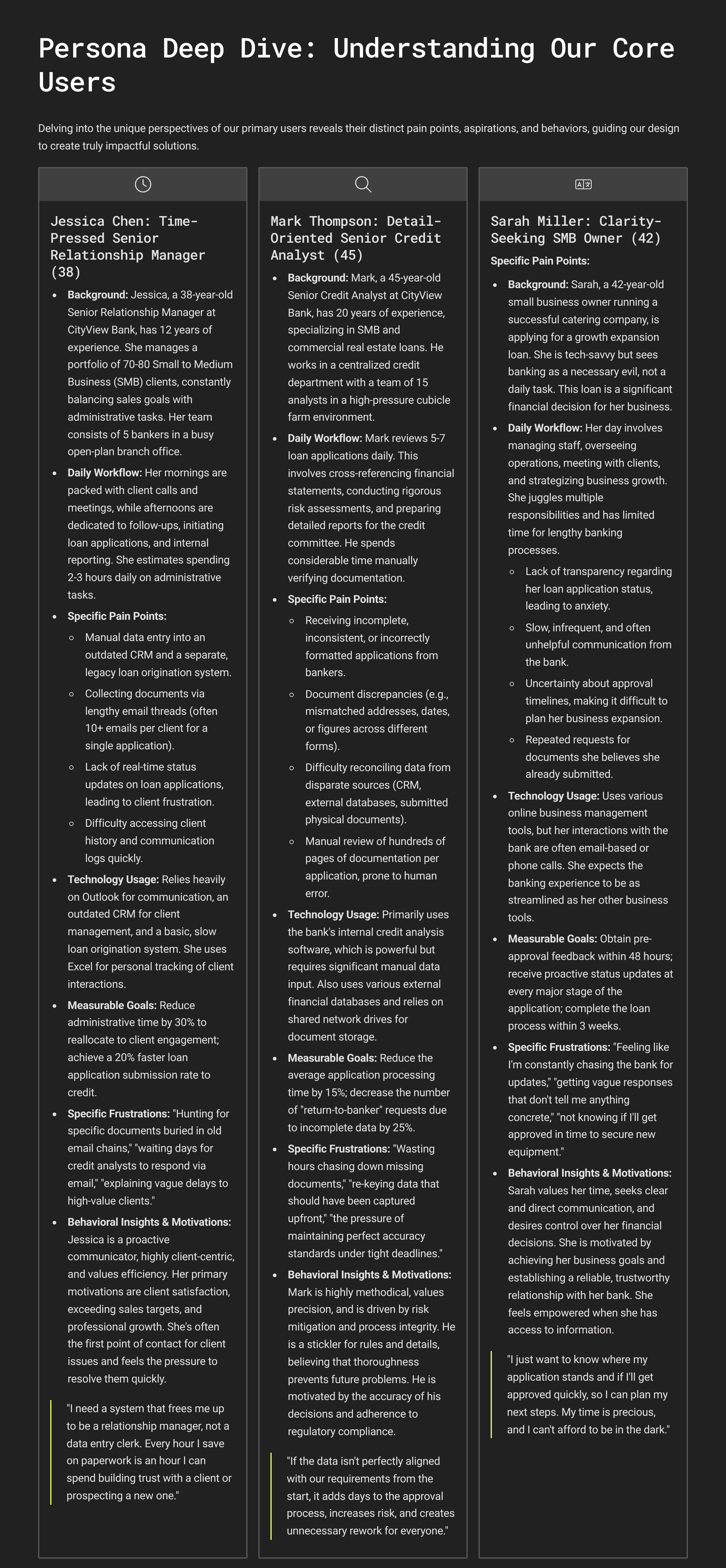
To ground design decisions, I led user interviews and frontline surveys targeting bankers and Sales Support agents. We developed personas representing typical users: the time-pressed banker juggling multiple clients, the detail-oriented Credit analyst, and the cautious client seeking clarity. These personas shaped UI design priorities around clarity, error reduction, and trust-building through transparency.
Bankers prioritized streamlined data capture to reduce manual notes and email reliance.
Credit analysts needed consistent, complete information aligned with Fulfilment requirements.
Clients desired faster pre-approval feedback and clear status updates.
Survey response rate: 78% (n=10 bankers) |
|---|
Persona profiles illustrating pain points and goals
Competitiveness’s Landscape & Differentiation
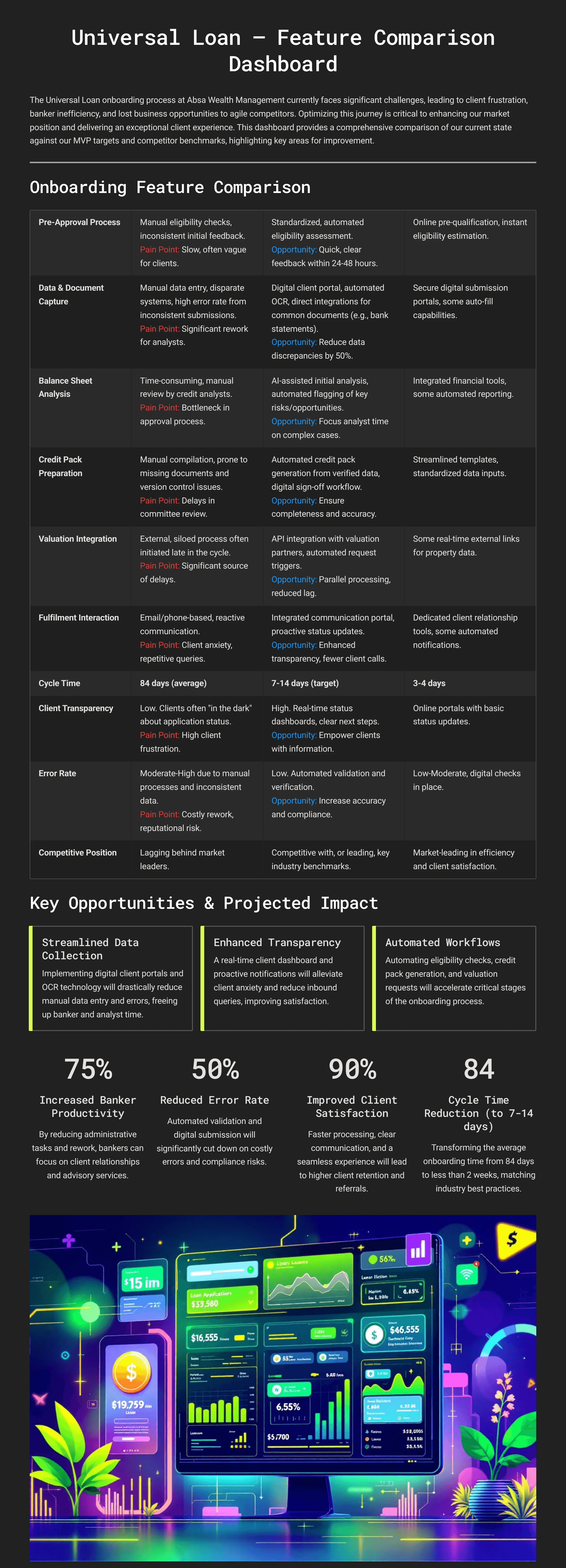
Our competitive analysis revealed that Home Loans outperformed Universal Loans due to automated pre-approval workflows and standardized documentation. Universal Loan’s manual onboarding introduced delays and errors, undermining client confidence. We differentiated by proposing a Salesforce-aligned UI that would unify data capture and embed a pre-approval step, creating a unique value proposition.
Feature | Universal Loan | Home loans |
|---|---|---|
Pre-approval Process | None | Automated, instant feedback |
Data & Document Capture | Manual, email-based | Integrated digital submission |
Approval Cycle Time | 84 days | 3-4 days |
Introducing an automated balance sheet analyzer aligns Universal Loan with competitive standards.
Standardised Credit approval templates reduce cross-team misalignment
Feature comparison dashboard highlighting gaps and opportunities
Product Strategy & Feature Prioritization
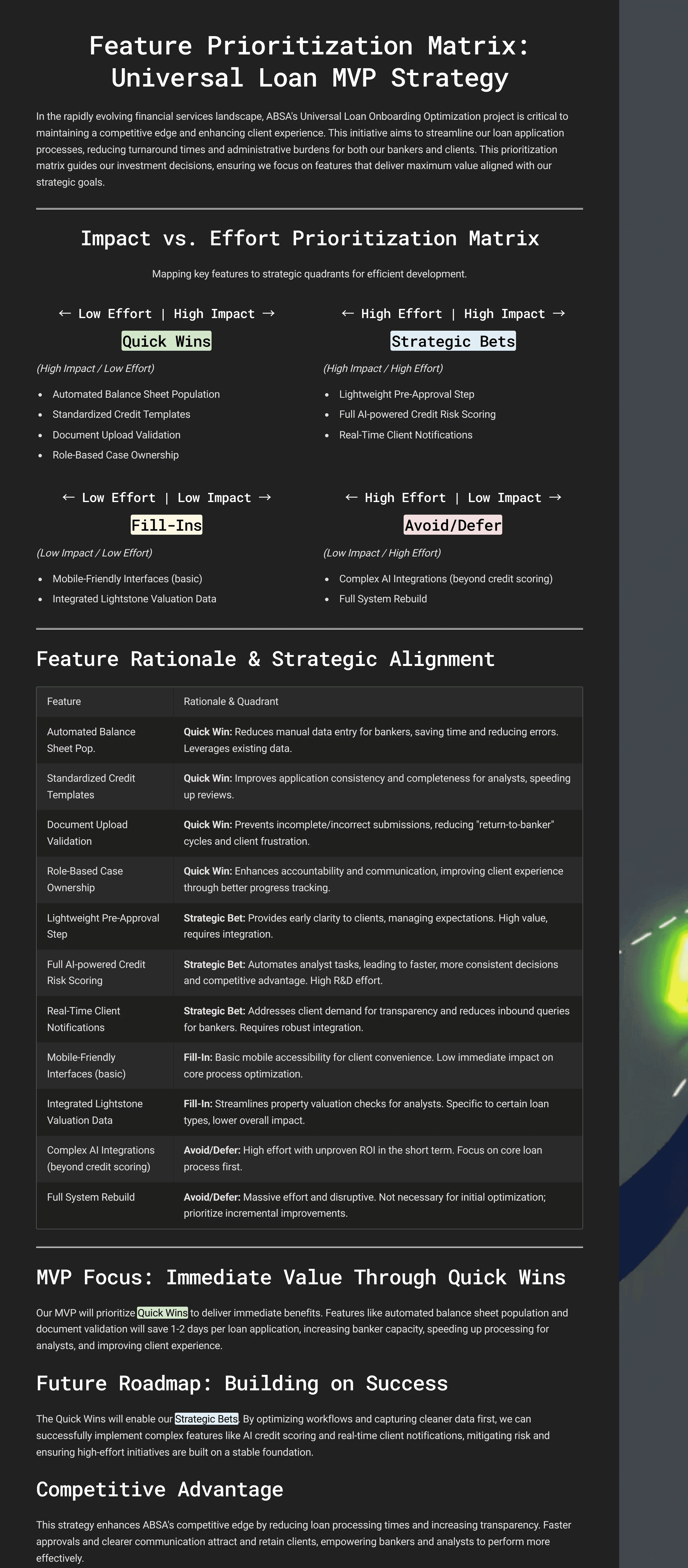
We prioritized features based on impact and feasibility, focusing on quick winsand foundational improvements. I advocated for automating balance sheetpopulation and standardizing Credit approval templates as immediate valuedrivers. The lightweight pre-approval step was slated as a strategic enhancement to rebuild client confidence and improve conversion.
Automated data capture to reduce manual errors and speed data verification.
Pre-approval functionality to provide early client assurance.
Salesforce screen redesign to standardize frontline workflows.
Projected time saved: 1.5 days per application |
|---|
Feature prioritization matrix with impact vs effort
Information Architecture & User Flows
I mapped the end-to-end onboarding process detailing each step: entry, document capture, verification, pack preparation, Credit assessment, and Fulfilment. This breakdown included system and tool dependencies, identifying bottlenecks and redundant handoffs. The new user flow simplified data entry points and integrated pre-approval feedback loops to enhance transparency.
Reduced data entry duplication by consolidating inputs into Salesforce screens.
Introduced checkpoints for real-time status updates to clients and bankers.
Aligned credit and fulfilment workflows to minimize rework and errors.
Detailed user flow diagram showing optimized handoffs
Image
Design System Creation & Components
To ensure consistency across Salesforce interfaces, I reused SDLC salesforce standard components to in our design systems tailored to the onboarding context. Components included standardized input fields, validation states, templated approval forms, and status indicators. This system reduced cognitive load for bankers and ensured alignment with FSC standards, facilitating faster adoption and fewer errors.
Reusable form templates to speed Credit approval documentation.
Clear visual cues for missing or incorrect documents.
Status badges to communicate process stages transparently.
Targeted metric - Design system adoption rate: 85% (within first 2 weeks). |
|---|
UI component library preview with form templates and status badges
Image
MVP Development & Testing Strategy
I collaborated closely with development to build Salesforce screen prototypes reflecting the prioritized features. We executed iterative testing cycles with frontline bankers, gathering qualitative feedback on usability and error rates. Adjustments focused on simplifying navigation, clarifying error messages, and improving document upload flows.
Rapid prototyping reduced solutioning uncertainty for stakeholders.
Usability testing highlighted the need for inline guidance on data fields.
Iterative feedback loops tightened alignment between design and development.
"The new UI cuts down the back-and-forth emails and makes tracking
application status much easier."
-Senior Banker, Gauteng region
Prototype screen showing standardized data capture workflow
Image
Branding & Visual Identity Integration
We ensured that the redesigned onboarding interfaces reflected the bank’s visual identity and FSC compliance standards. Color palettes, typography, and iconography were carefully selected to enhance readability and convey trust. Visual consistency across screens strengthened user confidence and reinforced brand integrity throughout the loan journey.
Used FSC-approved colors for UI elements related to approvals and errors.
Consistent iconography improved quick recognition of task status.
Typography optimized for accessibility and screen legibility.
Brand consistency score: 92% (internal audit) |
|---|
Style guide excerpt showing color and typography standards
Image
Go-to-Market Collaboration & Launch
I facilitated continuous engagement with leadership (Jay, Wendy) and frontline teams to ensure alignment and buy-in. We shared iterative deliverables including survey drafts, Figma prototypes, and process maps. This transparency enabled smooth training rollout and quick resolution of adoption barriers during launch.
Stakeholder workshops secured executive sponsorship and resource commitment.
Frontline training materials incorporated real-user scenarios and quick reference guides.
Post-launch support channels were established for immediate user assistance
Launch readiness: 100% trained frontline bankers (n=10) |
|---|
Training session snapshot with frontline bankers
Image
Adoption Metrics & User Feedback
Post-launch data demonstrated strong adoption and positive user reception. Task success rates improved significantly, with bankers reporting less time spent on manual corrections and document chasing. Client confidence rose due to the new pre-approval visibility. We mapped these improvements directly to introduced features and process changes.
+18% task success rate attributed to standardized data capture and validation.
–35% reduction in document-related errors driven by templated approvals.
+22% faster cycle time linked to automated balance sheet analysis.
Metric | Header 2 | Header 3 |
|---|---|---|
Task Success Rate | 62% | 80% |
Document Error Rate | 50% | 18% |
Average Cycle Time (days) | +-84 days | 7-14 days |
Growth Strategy & Product Roadmap
Building on the MVP success, we outlined a roadmap focusing on scaling automation, enhancing client transparency, and extending pre-approval capabilities. Future phases include integrating AI-powered document verification and real-time status notifications. Our growth strategy emphasises continuous stakeholder engagement and incremental delivery to sustain momentum and budget allocation.
Plan to incorporate AI-driven credit risk scoring for faster decisions.
Expand pre-approval to cover additional client segments.
Develop mobile-friendly interfaces to improve accessibility and adoption.
Roadmap completion target:+- 12 months |
|---|
Product roadmap timeline with key milestones and deliverable
Image
Gallery
Strategic process map highlighting onboarding pain points
Image
Visualizes the baseline process and identifies bottlenecks
Image
Persona profiles for bankers, Credit analysts, and clients
Image :Informs targeted design decisions based on user needs
Image :Competitive feature comparison table
Highlights gaps between Universal Loan and Home Loans
Image : . Salesforce screen prototype with standardized data capture
Demonstrates UI improvements reducing manual errors
Image : Design system component library overview
Ensures consistency and speeds up development
Image : Training session with frontline bankers
Supports effective adoption and knowledge transfer
Image : Product roadmap timeline showing future enhancements
Guides the strategic evolution of the onboarding product
Image: